

- Details
-
 By Pau Marí
When a production line depends on speed, accuracy, and uptime, equipment must be connected—not only mechanically, but also digitally. This includes the bottle unscrambler or the bottle orienter, which is often the first machine in the line.
To meet modern packaging automation standards, it must be connected to the plant’s digital systems: MES (Manufacturing Execution System), LIS (Line Integration System), and SCADA (Supervisory Control and Data Acquisition).
But how can this be done without being an IT specialist?
This article is a step-by-step, jargon-free guide for production and maintenance engineers who want to integrate an automatic bottle unscrambler into a connected factory environment. Whether you are upgrading your packaging line in Europe, the USA, or anywhere else in the world, this is the right starting point. POSIMAT’s global service team can support you at every stage of the process.
Proper integration is not just about connectivity—it is about ensuring high and consistent OEE (Overall Equipment Effectiveness). A digitally connected bottle unscrambler reduces downtime, enables faster changeovers, and significantly improves packaging line efficiency.
What Are MES, LIS, and SCADA—and Why Do They Matter?
- MES (Manufacturing Execution System): the brain of the factory. It schedules production, sends work orders to machines, and tracks operations in real time.
- LIS (Line Integration System): the translator. It connects different machines on the line—even from different suppliers—so they can communicate using a common logic.
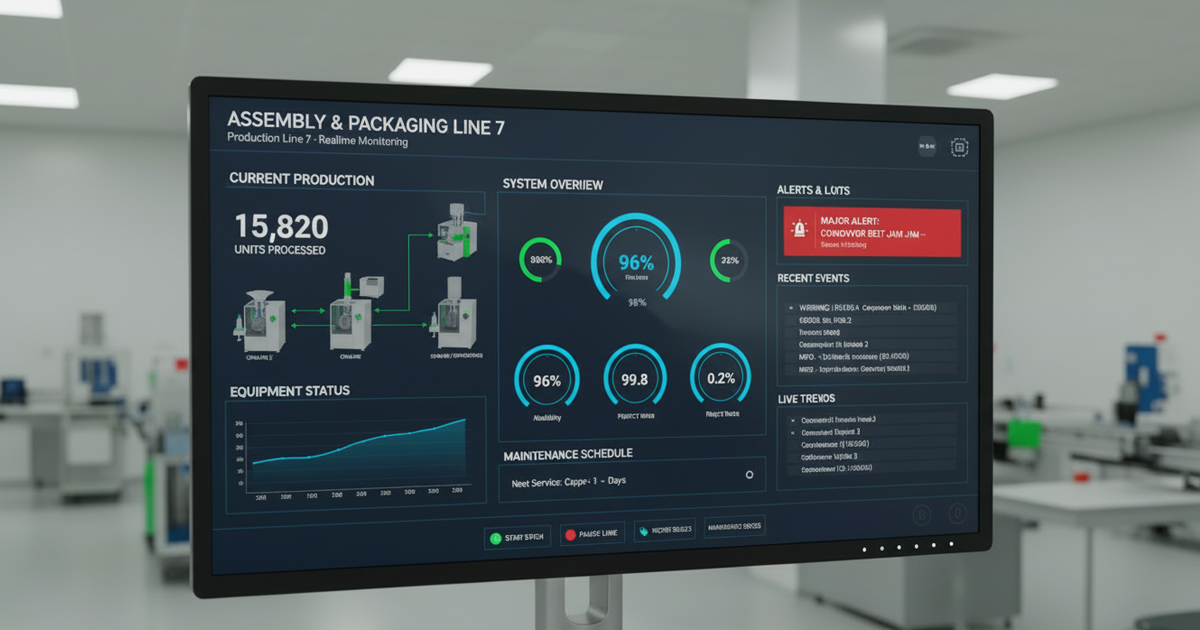
- SCADA (Supervisory Control and Data Acquisition): the visual dashboard. It allows operators and supervisors to see what is happening on every machine, at any moment.
Connecting a high-speed bottle unscrambler to these systems enables:
- Reduced downtime.
- Faster format changeovers.
- Easier troubleshooting.
- Real-time performance monitoring.
This is especially critical in pharmaceutical, cosmetic, chemical, and food & beverage environments, where uptime and traceability are essential.
Step 1 – Check the Machine’s Capabilities
Before connecting anything, ask your machine supplier:
- Does the bottle unscrambler have an Ethernet port? This is typically the communication entry point.
- Can it communicate using standard protocols such as Modbus, OPC UA, or MQTT?
Brief explanation:
- Modbus: a simple and widely used protocol for industrial data exchange.
- OPC UA: a modern protocol that enables secure and standardized communication between machines and systems.
- MQTT: a lightweight protocol designed for fast and reliable data transmission, commonly used in Industry 4.0 environments.
Request the communication capability documentation from your supplier. This information will be essential for your IT or automation team.
Step 2 – Coordinate with the IT or Automation Team
You are not doing this alone. Your IT or automation team will need to define:
- Data to receive from the unscrambler:
- Number of bottles processed.
- Machine status (Running, Stopped, Fault).
- Alarms.
- Changeover status.
- Data to send to the machine:
- Start/stop commands.
- Recipe or SKU selection.
Important: involve IT before finalizing any integration plan with the machinery supplier. Many projects are delayed because IT was not involved early and later blocks the setup due to security or network policies.
You do not need to configure the system—just define what data is needed and why it supports production.
Step 3 – Plan the Network Setup (the “IP Issue”)
Machines do not connect automatically to the plant network. Each one requires an IP address to communicate.
You will need to:
- Request an IP address for the bottle unscrambler from IT.
- Ensure the machine is connected to a secure industrial network, separate from the office network.
- Confirm that a gateway or router connects the machine to the MES or SCADA server.
This is where many issues arise. A machine may operate perfectly, but without proper network configuration it remains invisible to digital systems—especially critical in regulated industries.
Step 4 – Define Which Data Will Be Shared
Not all data needs to be shared—only what adds value.
Typical data from a high-speed bottle unscrambler includes:
- Bottles per minute.
- Total bottles processed.
- Machine status.
- Fault codes.
- Reject rate (if a bottle orienter is used).
- Active recipe or SKU.
Common data structuring approaches:
- PackML (Packaging Machine Language): a standardized model for machine states and data tags, highly recommended for modern packaging lines.
- Datablocks: structured PLC data blocks that group counters, states, and alarms for easy access by external systems.
This data is sent to MES or SCADA so operators and planners can visualize and analyze performance.
Step 5 – Test the Connection
Once the setup is complete:
- Run communication tests with the automation team.
- Verify that the system reads machine data correctly.
- Test commands such as recipe or SKU changes.
Run real production, monitor the data, and correct any inconsistencies.
Step 6 – Address Cybersecurity Risks
Once machines are connected, cybersecurity becomes critical. IT departments will ensure that:
- Only authorized users and systems can access the machine.
- Data transfers are secure, especially for remote access.
- External connections comply with corporate security policies.
Working with IT from the beginning avoids delays during commissioning.
Common Mistakes to Avoid
- Not involving IT early in the project.
- Assuming the machine is plug-and-play—every plant network is different.
- Sharing too much data from the start instead of focusing on what matters.
- Skipping operator training.
Real-World Benefits
Plants that integrate bottle unscramblers into MES/LIS/SCADA systems report:
- 10–20% less downtime.
- Faster changeovers.
- Better production reporting.
- Easier root-cause analysis during faults.
- Improved quality traceability.
Summary – Make Your Bottle Unscrambler Part of the Team
Integrating an automatic bottle unscrambler or bottle orienter into MES/LIS/SCADA systems does not require coding—it requires planning. Understanding machine capabilities, defining valuable data, and coordinating the right teams are the keys to success.
At POSIMAT, our equipment is designed for full digital integration. We support customers in Europe, the USA, and worldwide, ensuring that a bottle unscrambler is not just a machine, but a connected and intelligent part of the production line.
It’s time to connect your bottle unscrambler.
Transparency statement: This article was written by the Posimat team. Images and editorial language review have been optimized using artificial intelligence tools.