

- Details
-
 By Pau Marí
The rise of robotics in modern packaging automation lines has transformed the way plastic bottles are handled in filling operations.
From format changeovers without parts to higher flexibility, robotic systems are often perceived as the ultimate solution. However, when it comes to gentle handling, not all robots treat bottles equally.
In today’s competitive environment, whether you are searching for a bottle unscrambler in the USA (to compensate for the lack of manual labor) or evaluating packaging machinery in Europe (with a fast return on investment), it is crucial to understand the technical differences behind each solution.
Is every robotic bottle unscrambler truly better than a traditional automatic bottle unscrambler? Let’s analyze the key aspects.
Bottle Loading from Hopper to Picking Conveyor in a Robotic Bottle Unscrambler
One of the most critical stages in any bottle unscrambler, whether classic rotary gravity-based or robotic, is the transition from hopper to pre-positioning area, either a turning disc or picking belt, depending on the technology.
The Importance of Controlled Bottle Flow
The quantity of bottles entering the pre-positioning picking area is decisive.
Excessive bottle accumulation leads to aggressive pre-positioning. In a robotic unscrambler, pre-positioning means separating and arranging bottles so that the vision system and robotic arm can detect and pick them quickly and efficiently.
When too many bottles overlap on the infeed and need to be separated, systems often rely on:
- Vibratory channels.
- Mechanical sweepers.
- Other rapid separation devices.
These mechanisms can become abrasive, especially in high-speed bottle unscrambler configurations. Friction between bottles or against metallic guides can damage delicate surfaces: particularly critical in cosmetic packaging machinery and other high-end bottles.
Redundant and Non-Aggressive Pre-Positioning Systems
A well-designed robotic system should ensure that mechanical sweepers act only as safety backups, not as the primary positioning method.
Ideally, the sweeper should contact only a very small percentage of bottles. This is how POSIMAT robotic unscrambler POSIROBOT acts, as seen in the video.
Similarly, vibratory channels must be carefully engineered. Sudden shaking of channel walls inevitably causes friction marks.
When comparing suppliers, evaluate:
- Is bottle distribution controlled at the hopper level?
- Does the system minimize bottle stacking?
- Are aggressive vibratory elements constantly active?
These details determine whether you are investing in the best unscrambling technology or simply in a marketing concept.
Bottle Recirculation: A Hidden Source of Surface Damage
Not every bottle is picked successfully on the first attempt. The way a system handles unpicked bottles is a decisive factor in gentle handling.
Linear Robotic Systems and Recirculation
In many linear robotic bottle unscrambler systems, bottles that are not picked on the first attempt must be reintroduced into the picking flow.
This can be achieved through different engineered solutions, such as:
- A controlled return to the hopper.
- A lower recirculation conveyor that gently feeds bottles back to the picking area.
The key factor is not the linear architecture itself, but how the recirculation process is designed and controlled.
Well-developed Systems, like POSIMAT’s POSIROBOT, ensure smooth transfers, optimized speeds, and minimal friction points to preserve bottle integrity throughout the cycle.
Each additional handling step must be carefully engineered, especially when working with lightweight PET bottles commonly used in cosmetic, beauty care, and food and beverage applications.
Bottle material, static behavior, and line speed all influence performance, making technical design and fine adjustment essential.
In sectors such as chemical bottle handling equipment, minor surface marks may be less critical from a marketing standpoint. However, in beauty, personal care, and premium packaging, even micro-scratches can affect product perception.
For this reason, evaluating the quality of the recirculation design, rather than simply the robot configuration, is fundamental when comparing different technologies.
Rotative Robots and Zero Recirculation Technology
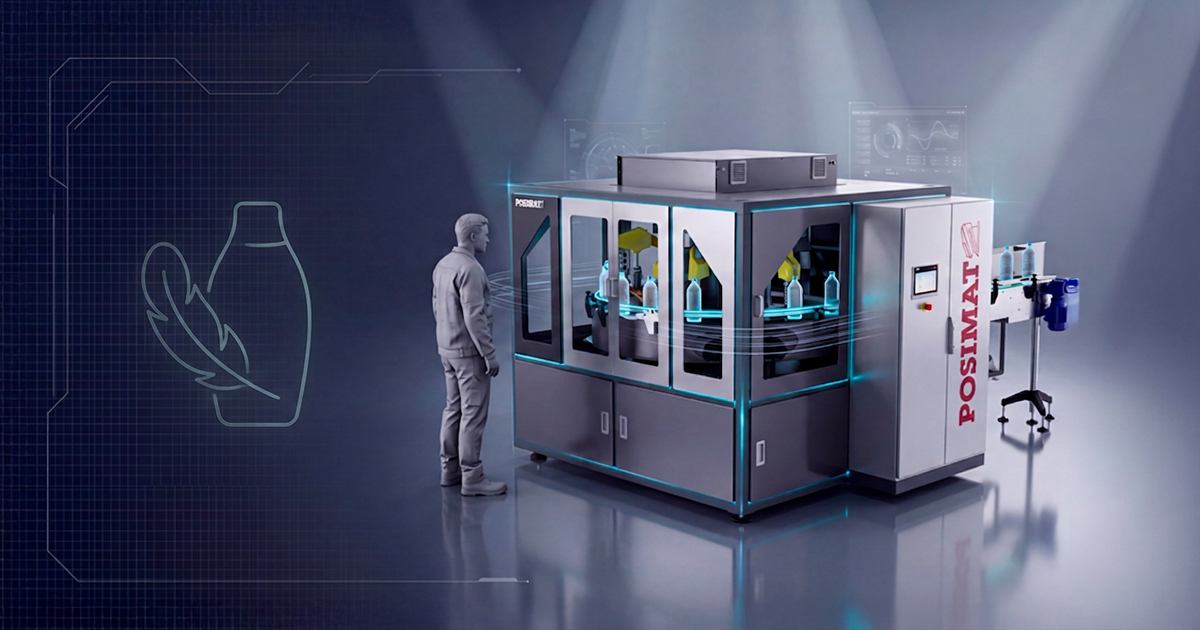
In rotative robotic systems such as COMPACTBOT, the traditional picking conveyor is replaced by a rotating disc.
Here, bottles that are not picked remain on the disc and continue moving synchronously until they are collected by the robotic arm.
There is:
- No bottle dropping.
- No additional conveyor.
- No re-entry into the hopper.
- No friction-based recirculation.
This eliminates an entire stress factor in the process.
The result is superior gentle handling, making it particularly suitable for cosmetic, beauty care, and personal care applications where surface integrity is paramount.
For companies seeking the best bottle unscrambler manufacturer, understanding this architectural difference is essential.
Bottle Discharge from Robot to Filling Line
Although less critical than pre-positioning or recirculation, the discharge stage also requires attention.
Gripping Technologies and Transfer Methods
Robotic systems may use:
- Direct positioning onto the exit belt.
- Magnetic carriers.
- Vacuum suction cups.
- Mechanical grippers.
Each gripping method interacts differently with the bottle surface and neck finish.
Poorly adjusted grippers can leave patterned marks that reveal contact points while vacuum cups present few risks for the bottle surface.
Quality Assessment During Factory Acceptance Test (FAT)
When evaluating any bottle unscrambler, or robotic bottle unscrambler, the Factory Acceptance Test (FAT) must include a structured and measurable quality assessment protocol.
Gentle handling should never be assumed: it must be verified.
A rigorous FAT procedure should include:
- Individual inspection of each bottle before entering the system.
All bottles should be checked and documented to identify any pre-existing marks or surface imperfections. - Marking of pre-existing defects.
This ensures full traceability and avoids attributing prior damage to the bottle orienter or unscrambling process. - Post-process comparison after passing through the bottle orienter.
Bottles must be carefully re-inspected once they exit the system, especially in high-speed bottle unscrambler configurations. - Scratch pattern analysis.
If marks are detected, it is essential to determine whether they appear randomly or follow a repeated pattern.
Patterned scratches often indicate a mechanical origin, such as guides and grippers. Random marks, on the other hand, may be linked to transfer points, or recirculation zones.
For industries such as cosmetic packaging machinery, this level of validation is not optional; it is a requirement.
A professional FAT quality assessment guarantees that the chosen solution truly delivers proven unscrambling technology and aligns with the expectations of premium packaging automation lines in Europe and the USA as well as any high-end products around the filling lines in the globe.
Material Considerations in High-Speed Bottle Unscrambler Applications
Bottle material plays a significant role.
Virgin PET (vPET) and recycled PET (rPET, PCR PET) behave differently in terms of static electricity and friction.
Lightweight bottles, increasingly common in sustainable packaging trends, are more sensitive to:
- Static buildup.
- Surface friction.
- Deformation under aggressive handling.
In such cases, collaboration with bottle manufacturers is key. Anti-static additives or surface treatments may be required.
This is especially relevant in pharmaceutical bottle unscrambler or premium cosmetic environments.
Conclusion: Choosing the Right Robotic Bottle Unscrambler for Your Application
When comparing solutions, do not assume that robotics automatically means better surface protection.
Analyze the full bottle journey, from hopper to discharge.
The best bottle unscrambler manufacturer will provide:
- Transparent technical data.
- Real FAT surface tests.
- Optimized pre-positioning.
- Minimal or zero recirculation.
- Application-specific configuration.
- The most suitable gripping method to avoid scuffing, like vacuum cups instead of mechanical grippers.
In modern packaging automation lines, especially in cosmetic and pharmaceutical sectors, gentle handling is not a marketing claim: it is a measurable engineering outcome.
Selecting the right automatic robotic bottle unscrambler ensures efficiency, protects brand image, and delivers long-term operational reliability.
Transparency statement: This article was written by the Posimat team. Images and editorial language review have been optimized using artificial intelligence tools.